

Not financial advice: this post is for education and information only. Please read our full Disclaimer before acting on anything you read here.
Friday was the whole story this week. A weak September jobs report crushed the odds of an October Fed hike, bond yields fell, and chip stocks — the market’s most rate-sensitive trade — ripped higher, putting six semiconductor names on this week’s list. The single biggest gap of the week belonged to a biotech (Summit Therapeutics on an AstraZeneca deal), and Accenture was the week’s only earnings-driven qualifier, gapping up 17.8% on its quarterly report. All ten filters were maxed: this screen holds a maximum of ten names.
In this post
- This week’s qualifiers
- SMMT — Summit Therapeutics
- ACN — Accenture
- SNPS — Synopsys
- HPE — Hewlett Packard Enterprise
- ON — ON Semiconductor
- MCK — McKesson
- MRVL — Marvell Technology
- TER — Teradyne
- TXN — Texas Instruments
- MTSI — MACOM Technology Solutions
- Screen B: oversold bounces
- Scorecard: grading the September 25 picks
- The week in markets
This week’s qualifiers
| Symbol | Company | Gap day | Gap | Fri close | Screen |
|---|---|---|---|---|---|
| SMMT | Summit Therapeutics | Tue 9/29 | +22.16% | $16.76 | A — gap-up |
| ACN | Accenture | Thu 10/1 | +17.78% | $198.90 | A — gap-up |
| SNPS | Synopsys | Thu 10/1 | +7.57% | $489.90 | A — gap-up |
| HPE | Hewlett Packard Enterprise | Wed 9/30 | +6.94% | $69.33 | A — gap-up |
| ON | ON Semiconductor | Fri 10/2 | +5.83% | $84.89 | A — gap-up |
| MCK | McKesson | Thu 10/1 | +3.83% | $902.28 | A — gap-up |
| MRVL | Marvell Technology | Fri 10/2 | +3.70% | ~$272.29 | A — gap-up |
| TER | Teradyne | Fri 10/2 | +3.61% | $449.04 | A — gap-up |
| TXN | Texas Instruments | Fri 10/2 | +3.09% | $293.80 | A — gap-up |
| MTSI | MACOM Technology Solutions | Fri 10/2 | +3.08% | $321.60 | A — gap-up |
| CCL | Carnival | Tue 9/29 | +13.41% | $25.11 (Tue close) | B — bounce |
| FICO | Fair Isaac | Thu 10/1 | +11.69% | $661.75 (Thu close) | B — bounce |
| GEN | Gen Digital | Wed 9/30 | +5.61% | $22.02 (Wed close) | B — bounce |
Only ACN is an earnings-strength (Tier 1) qualifier — it reported Thursday before the bell. The other nine are news-driven (Tier 2). Screen B produced three oversold-bounce qualifiers this week (see below). The biggest moves that failed one or more filters are graded in this weekend’s standalone near-misses post, The Ones That Didn’t Make It: This Week’s Near-Misses (October 2, 2026).
SMMT — Summit Therapeutics
What happened
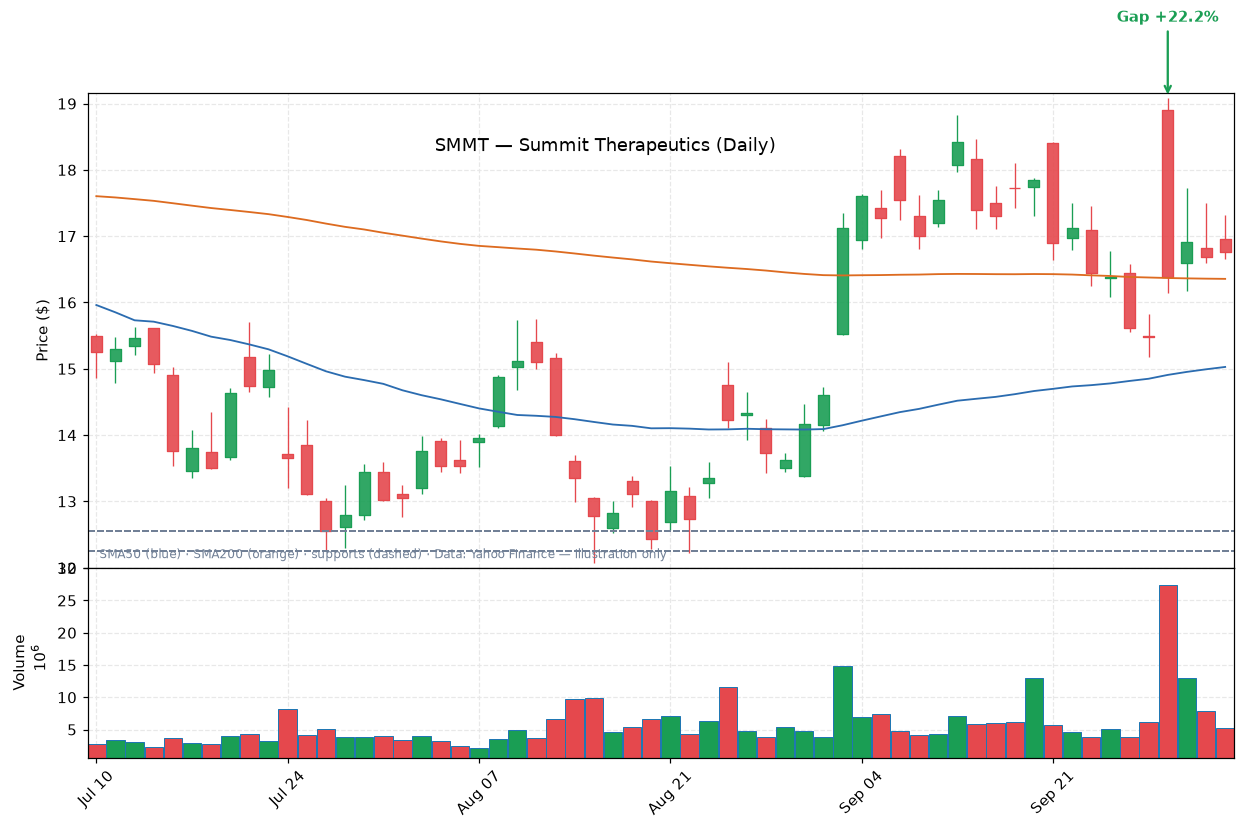
Summit Therapeutics gapped up 22.16% at Tuesday’s open — the largest qualifying gap of the week by a wide margin. The catalyst came late Monday: AstraZeneca announced a $2 billion strategic equity investment in Summit — roughly 109,000 convertible preferred shares at an effective $18.36 per common share, about a 12% stake — plus a clinical collaboration pairing Summit’s ivonescimab with AstraZeneca’s sonesitatug vedotin in gastrointestinal cancers. When a pharma giant writes a $2B check into a biotech, the market pays attention: Tuesday’s volume ran 3.7× average.
The gap faded from the open — Tuesday closed up just 5.9% at $16.39 — but it held green, and by Friday the stock had steadied at $16.76. Honesty requires a caveat here: Summit is a pre-revenue clinical-stage biotech with a trailing-twelve-month net loss of −$856 million, 26.26% short interest, and a Piotroski F-Score of 2. It passes the written filters (market cap $13.37B, above the $10B floor), but it is speculative by nature.
The numbers
- Opening gap: +22.16% (opened $18.91 vs Monday’s $15.48 close)
- Friday close: $16.76
- Market cap: ~$13.37 billion · Day’s volume: 27.34M vs 7.40M average (~3.7×)
- 14-day RSI: 54.47 — leads large-cap biotech peers (Gilead 43.49, Amgen 47.63, Vertex 39.03, Regeneron 34.98)
- Position vs trend: $16.76 vs 200-day moving average of $16.36 — just +2.4% above (thin margin)
- Tier: News-driven (next earnings October 19)
+22.16% — SMMT’s Tuesday opening gap, the week’s largest, on AstraZeneca’s $2 billion strategic investment.
Bull case vs bear case
The bull case is straightforward: AstraZeneca’s $2B vote of confidence validates Summit’s ivonescimab program, and the GI-cancer collaboration with sonesitatug vedotin opens a genuinely large market. The bear case is the speculative profile — a pre-revenue biotech with heavy short interest and a 2.4%-above-the-200-day position is one bad trial update from unwinding the whole move.
What to watch
The $16.36 200-day moving average is now a knife-edge. A close below it would flip the trend filter this stock barely passes. October 19 is the next earnings date — the next real binary event for this name.
Disclosure: this is an affiliate link — if you sign up through it, The Gap Up may earn a commission at no extra cost to you.
ACN — Accenture
What happened
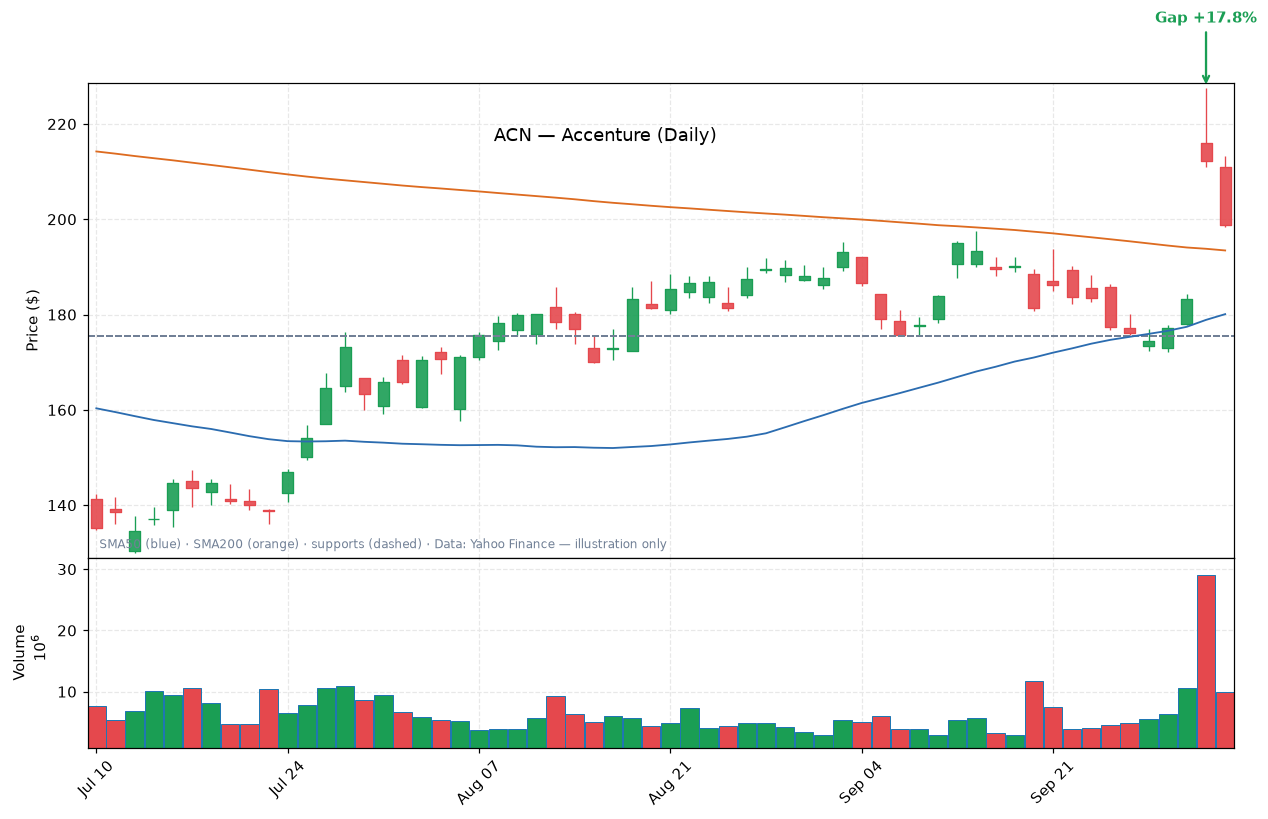
Accenture is the week’s only earnings-driven (Tier 1) qualifier. It reported fiscal Q4 2026 before the bell Thursday: EPS of $3.29 vs $3.18 expected, revenue of $18.68 billion vs $18.03 billion expected, and record fiscal 2026 bookings of $84.5 billion. The stock gapped up 17.78% at Thursday’s open and closed the day up 15.8% at $212.30 — volume ran 4.4× average, the heaviest institutional participation of any name on this list.
Friday cooled off: ACN gave back 6.3% to close at $198.90. But the gap survived the week, and Friday’s close sits just above the 200-day moving average — passing, but only just.
The numbers
- Opening gap: +17.78% (opened $215.98 vs Wednesday’s $183.37 close)
- Friday close: $198.90 (−6.3% Friday, gap intact)
- Market cap: ~$121.7 billion · Gap-day volume: 29.0M vs 6.6M average (~4.4×)
- 14-day RSI: 59.1 — above the IT-sector mean of 56.6, but essentially at the sector median (59.0) — borderline
- Position vs trend: $198.90 vs 200-day moving average of $195.91 — just +1.5% above (thin margin)
- FY2027 guidance: revenue growth of 3–6% in local currency; EPS $14.39–$14.81
- Tier: Earnings strength (reported Thursday, October 1, before the open)
$84.5 billion — Accenture’s record fiscal 2026 bookings, the single biggest fundamental number behind this week’s earnings gap.
Bull case vs bear case
The bull case: a clean beat on both lines, record bookings, and a healthy FY2027 guide — plus 4.4× volume says institutions, not day-traders, did the buying. The bear case is the softness of the setup: an RSI at the sector median (not leading) and a Friday close only 1.5% above the 200-day line make this the softest qualifier on the list alongside TXN and MTSI. One more weak week and the trend filter fails.
What to watch
Watch $195.91, the 200-day moving average. A close below it breaks the trend filter and unwrites the whole qualification. Also watch whether the $212.30 Thursday close — and Friday’s intraday slide — marks short-term exhaustion of the earnings pop.
Open ACN in TradingView
Disclosure: this is an affiliate link — if you sign up through it, The Gap Up may earn a commission at no extra cost to you.
SNPS — Synopsys
What happened
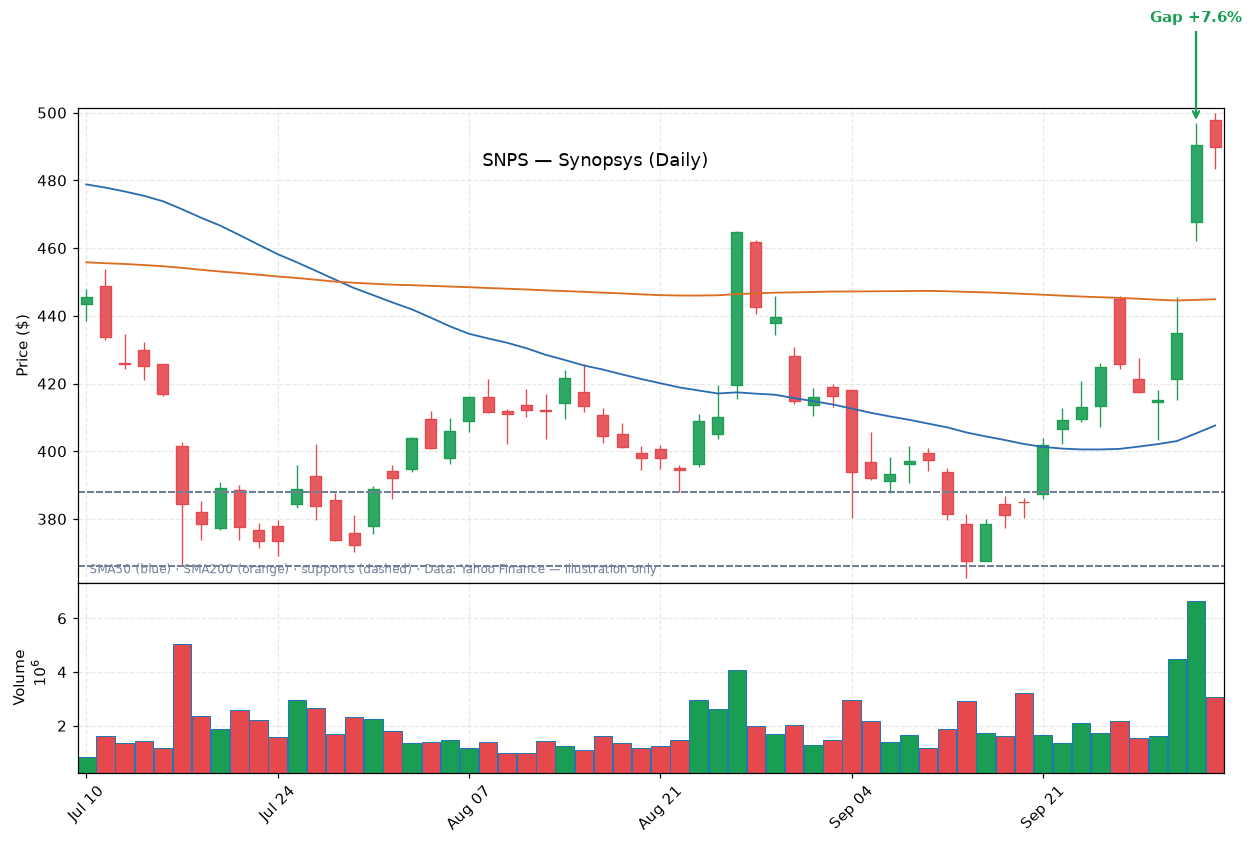
Synopsys gapped up 7.57% Thursday on fallout from its Wednesday Investor Day. The company raised its fiscal 2027 outlook sharply — revenue of $11.10–11.20 billion vs $10.81 billion expected, EPS of $19.04–19.12 vs $17.81 expected — announced a multi-year OpenAI deal, a $1 billion-plus chip-IP deal with AWS, and a ~$1 billion buyback. Deutsche Bank raised its price target to $640. This is guidance raised at an Investor Day, not a quarterly earnings report, so it ranks as Tier 2 (news-driven).
The gap didn’t just hold — it extended. Thursday closed up 12.8% at $490.54, and Friday closed at $489.90. Notably, Synopsys failed this screen’s 200-day filter last week; Thursday’s move pushed it back above the line.
The numbers
- Opening gap: +7.57% (opened $467.85 vs Wednesday’s $434.94 close)
- Friday close: $489.90 — gap held and extended
- Market cap: ~$93.9 billion · Gap-day volume: 6.7M vs 2.0M average (~3.4×)
- 14-day RSI: 74.1 — ranked 3rd of 74 IT stocks; clearly sector-leading
- Position vs trend: $489.90 vs 200-day moving average of $444.90 — comfortably above
- Tier: News-driven (guidance raised at the September 30 Investor Day)
+12.8% — Synopsys’ Thursday close, the strongest follow-through of any gap this week, with the 14-day RSI at 74.1.
Bull case vs bear case
The bull case: raised guidance backed by real deals (OpenAI, $1B+ AWS) is about as solid a fundamental catalyst as exists, and the stock reclaimed its 200-day line with conviction. The bear case: an RSI of 74 is hot — readings above 70 mean the short-term trade is crowded, and Deutsche Bank’s $640 target sets a bar that leaves little room for disappointment.
What to watch
Watch the $444.90 200-day moving average — the line it fought to reclaim. Holding above it keeps the recovered-trend thesis alive. Also watch for analyst follow-through after the Investor Day; the OpenAI deal terms are still thin on detail.
Open SNPS in TradingView
Disclosure: this is an affiliate link — if you sign up through it, The Gap Up may earn a commission at no extra cost to you.
HPE — Hewlett Packard Enterprise
What happened
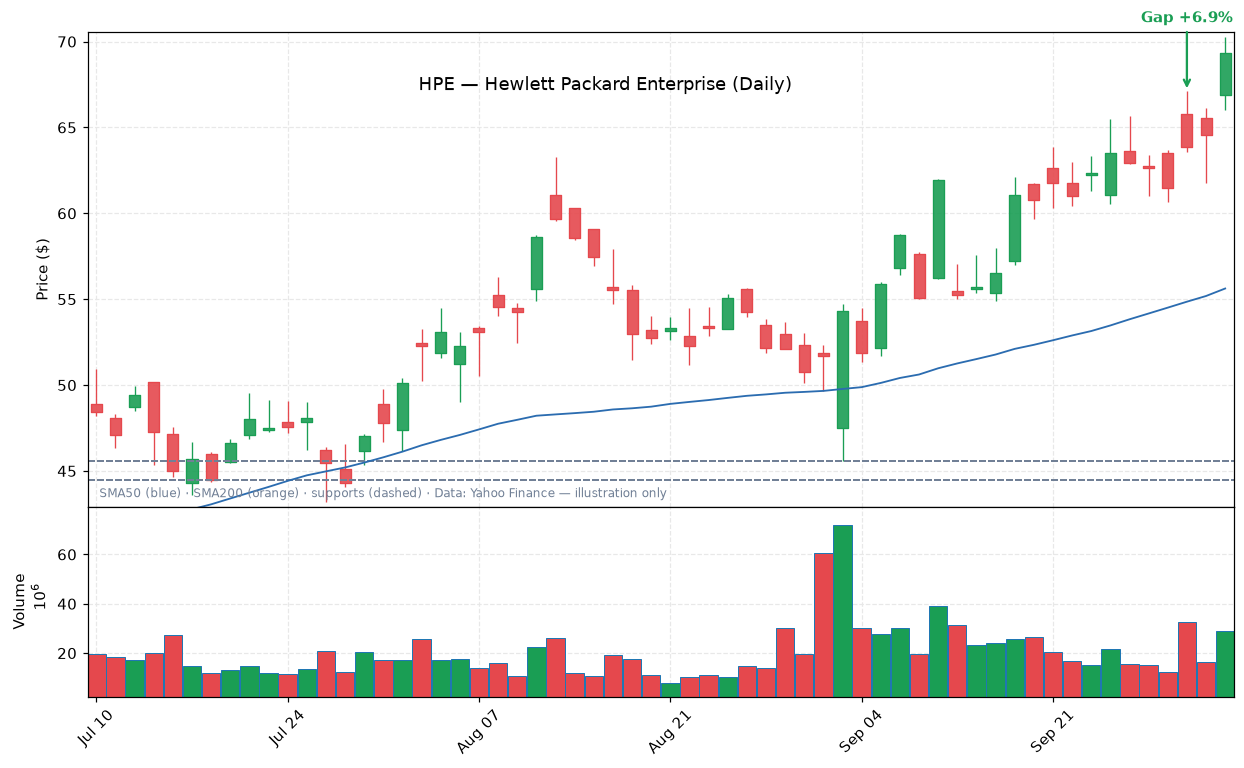
Hewlett Packard Enterprise gapped up 6.94% at Wednesday’s open on a genuinely company-specific catalyst: a $1.2 billion order from Vultr for AMD Helios AI Rack systems — HPE’s first-ever Helios win. Ahead of its Networking Investor Day, the company also raised its fiscal 2027 networking revenue growth outlook to the high-teens to low-20s and lifted its Juniper synergy target to $800 million. Wednesday’s session faded from the open (closed +3.9% at $63.89), but the stock rebuilt through the week to close Friday at $69.33. This is the strongest setup on the list by the trend metrics: far above the 200-day line and a clearly leading RSI. No earnings this week — pure news-driven, Tier 2.
The numbers
- Opening gap: +6.94% (opened $65.76 vs Tuesday’s $61.49 close)
- Friday close: $69.33 — gap held, faded Wednesday, recovered into Friday
- Market cap: ~$92.0 billion · Gap-day volume: 32.8M vs 20.4M average (~1.6×)
- 14-day RSI: 69.5 — ranked 11th of 74 IT stocks, well above the sector mean of 56.6 — leading
- Position vs trend: $69.33 vs 200-day moving average of $36.90 — far above
- Tier: News-driven ($1.2B Vultr order + raised networking outlook)
$1.2 billion — the Vultr AMD Helios AI Rack order, HPE’s first Helios win, announced September 30.
Bull case vs bear case
The bull case: a $1.2B order plus raised outlook and a lifted Juniper synergy target is a triple stack of good news, and the stock sits far above every trend line with leading momentum. The bear case: Wednesday’s intraday fade (from a ~9% intraday high to +3.9% close) showed real selling into strength — someone used the pop to exit.
What to watch
Watch whether the stock builds on Friday’s $69.33 or stalls there — Wednesday’s intraday high is now short-term resistance. The Networking Investor Day follow-through (and any new Helios orders) is the next fundamental read.
Open HPE in TradingView
Disclosure: this is an affiliate link — if you sign up through it, The Gap Up may earn a commission at no extra cost to you.
ON — ON Semiconductor
What happened
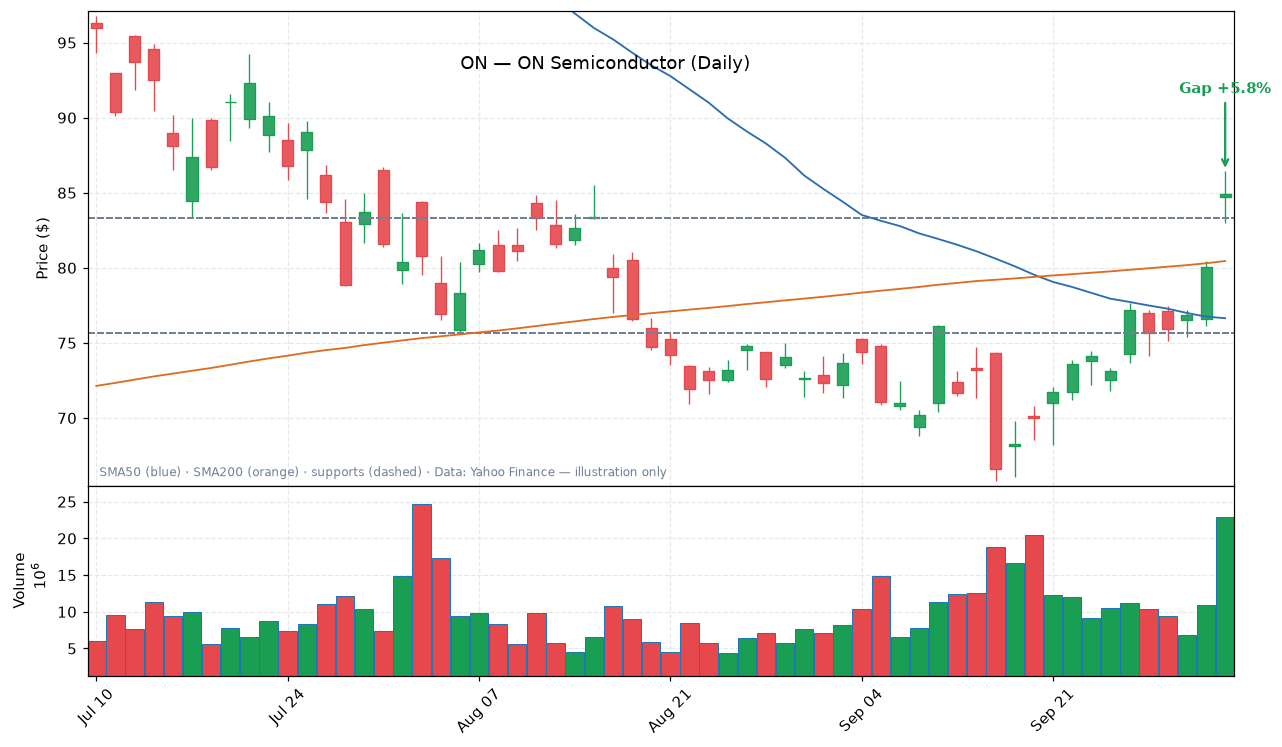
ON Semiconductor gapped up 5.83% at Friday’s open on a revised merger agreement with Synaptics announced late Thursday: an all-cash $123 per share (~$5.7 billion) deal replacing the June all-stock agreement (~$7 billion at 1.35 ON shares per Synaptics share). The revision followed an unsolicited competing proposal for Synaptics. Cash instead of stock removes the dilution overhang (no new ON shares get issued), and the new terms are expected to be immediately accretive to non-GAAP EPS — that’s finance-speak for “earnings per share go up right away.” ON rose 6.9% after-hours Thursday; Synaptics jumped 16%. The Friday gap held into the close at $84.89.
A $2.45 billion Morgan Stanley term loan funds the deal, with a targeted close in mid-2027. Tier 2, news-driven (M&A).
The numbers
- Opening gap: +5.83% (opened $84.75 vs Thursday’s $80.08 close)
- Friday close: $84.89 (+6.01% on the day) — gap held
- Friday volume: 22.88M vs 20-day average of 12.32M (~1.9×)
- Market cap: ~$33.05 billion
- 14-day RSI: 65.49 — above the ~63.0 large-cap semiconductor peer average
- Position vs trend: $84.89 vs 200-day moving average of $80.46 — +5.5% above (thin margin)
- Tier: News-driven (M&A)
$5.7 billion — the all-cash price for Synaptics, replacing the all-stock deal and removing the dilution overhang on ON shares.
Bull case vs bear case
The bull case: the market clearly prefers the cash deal — no new-share dilution, immediately accretive, and Synaptics’ assets fill real gaps in ON’s portfolio. The bear case: the 200-day margin is thin (+5.5%), so a down week flips the trend filter; and the deal was revised because of a competing bidder, which means price discipline mattered here — watch that the $123/share price doesn’t become a future regret.
What to watch
The $80.46 200-day line is the first support to mind. Beyond that, watch regulatory review of the deal and whether any further competing bids surface before the targeted mid-2027 close.
Open ON in TradingView
Disclosure: this is an affiliate link — if you sign up through it, The Gap Up may earn a commission at no extra cost to you.
MCK — McKesson
What happened
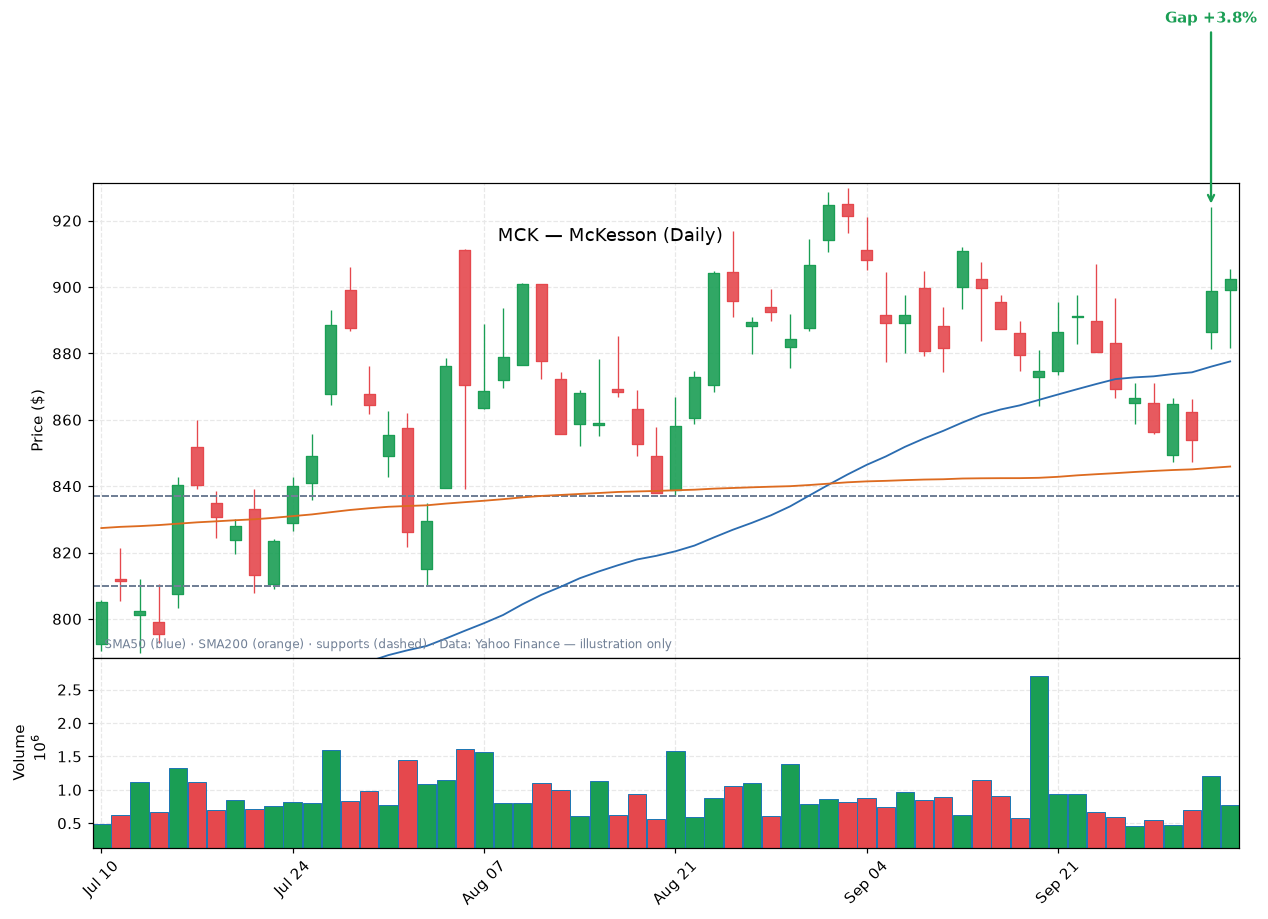
McKesson — one of the country’s giant drug distributors — gapped up 3.83% at Thursday’s open on an agreement in principle to extend its CVS Health pharmaceutical distribution partnership through June 2032. A six-year extension of a marquee customer is exactly the kind of quiet, durable good news that moves steady-Eddie healthcare stocks. The company also reaffirmed fiscal 2027 adjusted EPS guidance of $44.20–$45.00 and its long-term 13–16% EPS growth target. Thursday closed up 5.3% at $898.82, and Friday added a little more to $902.28 — the gap held and extended. Tier 2, news-driven.
The numbers
- Opening gap: +3.83% (opened $886.47 vs Wednesday’s $853.81 close)
- Friday close: $902.28 — gap held and extended
- Market cap: ~$105.2 billion · Gap-day volume: 1.21M vs 938k average (~1.3×)
- 14-day RSI: 56.9 — ranked 7th of 60 Health Care stocks, above the sector mean of 45.9 — leading
- Position vs trend: $902.28 vs 200-day moving average of $847.42 — comfortably above
- Tier: News-driven (CVS partnership extension through June 2032)
June 2032 — the new end date of McKesson’s CVS Health distribution partnership, locking in six more years of a core revenue stream.
Bull case vs bear case
The bull case: distribution contracts are McKesson’s moat, and extending CVS through 2032 with reaffirmed guidance is visibility most companies would envy. The bear case: this was already a richly performing stock ($105B market cap, well above trend), and partnership extensions are incremental, not transformational — a 3.8% gap on contract-extension news may be all there is.
What to watch
Watch the $847.42 200-day line as deep support — unlikely to be tested soon, but it’s the trend filter’s floor. More relevantly, watch whether the rest of this week’s healthcare distribution names firm up around the same catalyst.
Open MCK in TradingView
Disclosure: this is an affiliate link — if you sign up through it, The Gap Up may earn a commission at no extra cost to you.
MRVL — Marvell Technology
What happened
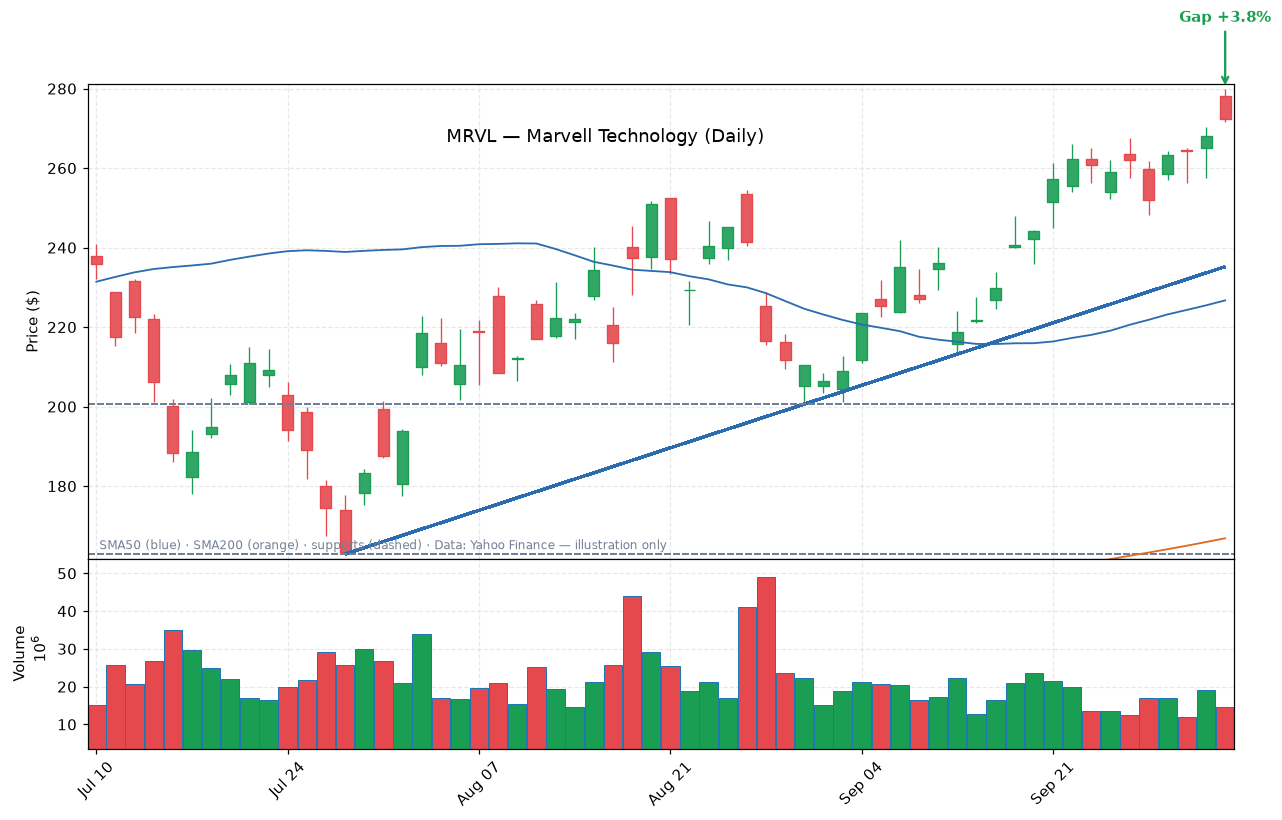
Marvell gapped up 3.70% at Friday’s open on the sector-wide chip rally — the weak September jobs report crushed October Fed-hike odds, and rate-sensitive semiconductors ripped. There was no fresh company-specific news Friday: one recap’s “AT&S deal expansion” headline is stale — that collaboration was announced September 22. Earlier in the week, Citi reiterated its Buy rating with a $275 target (September 29) ahead of the October 6 investor day. This is a pure sector-momentum gap, Tier 2.
Honesty requires the caveat: the gap faded intraday — from +3.70% at the open to roughly +1.6% by the close (~$272.29). It still passed the written filters, but this is the weakest follow-through on the list.
The numbers
- Opening gap: +3.70% (opened $278.00 vs Thursday’s $268.08 close)
- Friday close: ~$272.29 (+~1.6% on the day) — gap faded intraday
- Market cap: ~$238.78 billion · Average volume: 17.56M shares daily
- 14-day RSI: 64.96 — above the ~63.0 large-cap semiconductor peer average
- Position vs trend: far above the 200-day moving average ($166.91)
- Tier: News-driven (sector momentum — the weak jobs report’s chip rally)
$238.78 billion — Marvell’s market cap, making it the largest company on this week’s list.
Bull case vs bear case
The bull case: at $239B with a leading RSI and a $275 Citi target ahead of the October 6 investor day, Marvell is a proven AI-connectivity leader riding the right wave. The bear case: this gap had no company news and faded intraday — the softest possible version of a qualifier, and a reminder that sector momentum alone is a fragile foundation.
What to watch
October 6 — the investor day — is the next real event; any substance there either validates Friday’s gap or exposes it. Watch the $268.08 gap-day-low area: a break below the open’s foundation would confirm the fade.
Open MRVL in TradingView
Disclosure: this is an affiliate link — if you sign up through it, The Gap Up may earn a commission at no extra cost to you.
TER — Teradyne
What happened
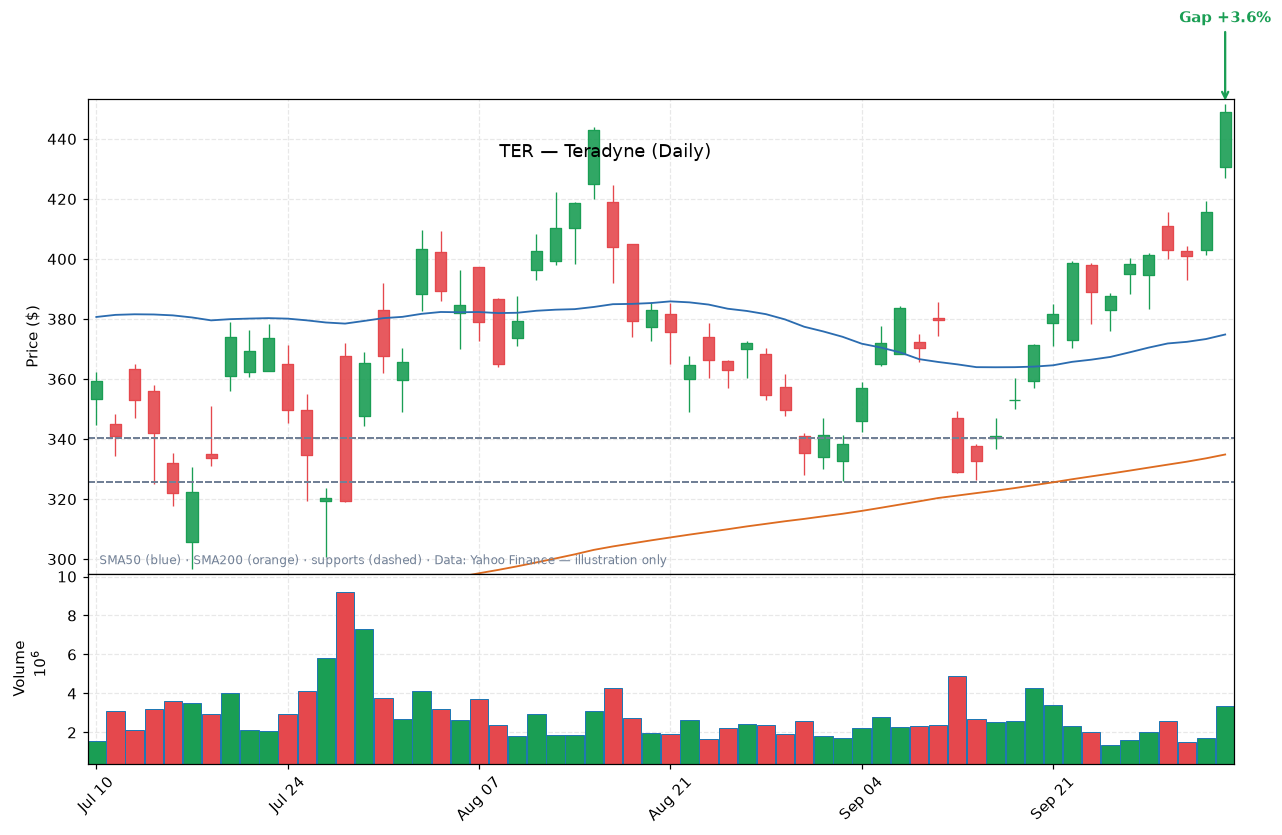
Teradyne — which makes the machines that test memory chips — gapped up 3.61% at Friday’s open and kept going, closing +8.00% at $449.04. That makes it the strongest Friday follow-through on the list: the gap didn’t just hold, it extended. Two things fed the move: the sector-wide chip rally on the weak jobs report (the SOX index hit a 3-month high, with Teradyne among its top gainers), and company-specific news — Teradyne announced its Magnum E2 next-generation high-speed memory test system for advanced DRAM and NAND earlier in the week. The stock also cleared an IBD early-entry buy point at 444.17. Tier 2, news-driven (sector momentum plus product news).
The numbers
- Opening gap: +3.61% (opened $430.80 vs Thursday’s $415.79 close)
- Friday close: $449.04 (+8.00% on the day) — gap held and extended
- Market cap: ~$70.20 billion · Friday volume: 3.36M vs 2.55M average (~1.3×)
- 14-day RSI: 69.59 — above the ~63.0 large-cap semiconductor peer average
- Position vs trend: $449.04 vs 200-day moving average of $335.06 — far above
- Tier: News-driven (Magnum E2 product launch + chip-sector rally)
+8.00% — Teradyne’s Friday close, the strongest same-day extension of any gap this week.
Bull case vs bear case
The bull case: product news plus sector momentum is the best combination on this list — the Magnum E2 launch gives the move a fundamental anchor, and memory-test demand rides directly on the AI data-center buildout. The bear case: at $70B with a 69.6 RSI, the stock is running hot and far above its 200-day line — extended stocks correct hard when sector momentum cools.
What to watch
Watch whether $444.17 — the IBD early-entry buy point it cleared Friday — now acts as support. Any failure to hold above it would signal the Friday extension was the top for now.
Open TER in TradingView
Disclosure: this is an affiliate link — if you sign up through it, The Gap Up may earn a commission at no extra cost to you.
TXN — Texas Instruments
What happened
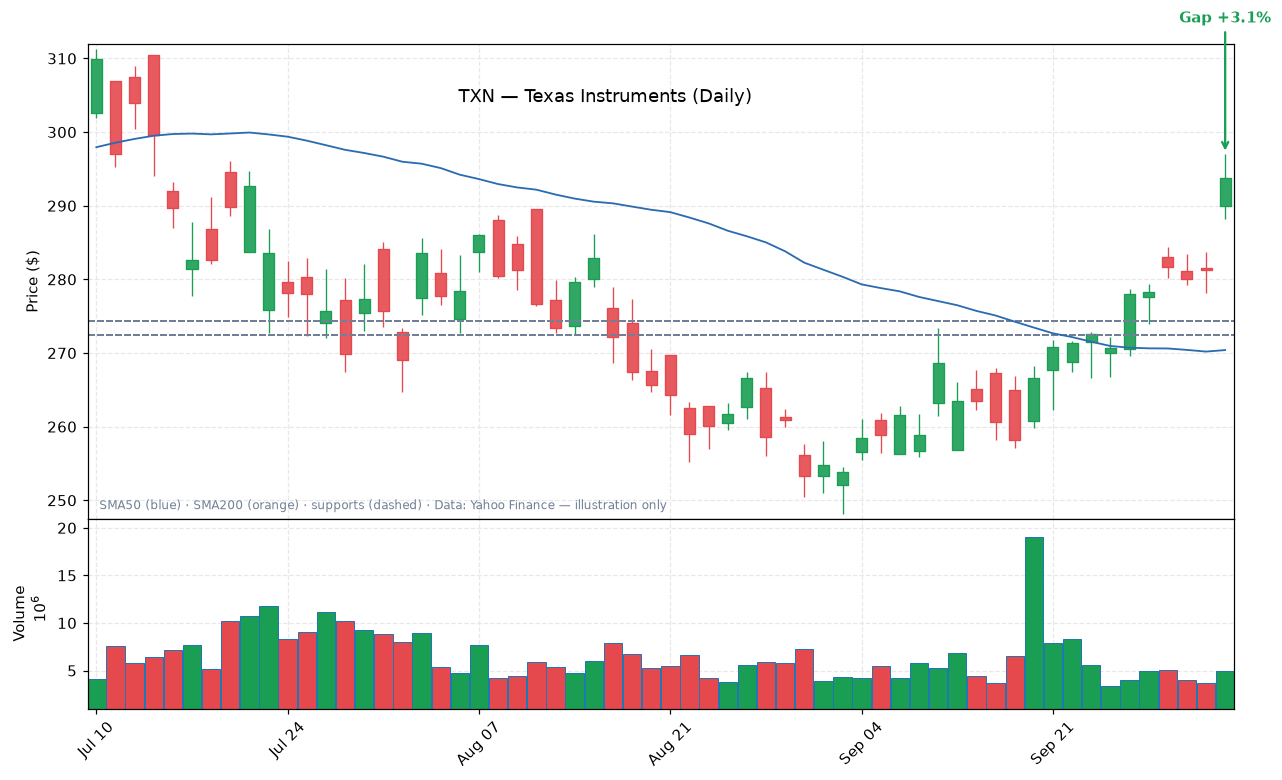
Texas Instruments gapped up 3.09% at Friday’s open — just barely over the 3% bar that defines a real gap-up — and held it into the close, finishing +4.44% at $293.80. The driver was the same Friday chip rally that lifted MRVL and TER: the weak September jobs report collapsed October Fed-hike odds, and rate-sensitive semis were the market’s favorite rebound trade. No company-specific news was identified for TI on Friday — this is a pure sector-momentum qualifier, Tier 2.
Two honest caveats: at +3.09% this is the second-weakest qualifying gap on the list (just above MTSI’s +3.08%), and Friday’s volume ran below average — the move came on conviction, not on crowd participation.
The numbers
- Opening gap: +3.09% (opened $290.00 vs Thursday’s $281.31 close) — barely qualifies
- Friday close: $293.80 (+4.44% on the day) — gap held
- Market cap: ~$268.31 billion · Friday volume: 4.92M vs 5.84M average (below average)
- 14-day RSI: 70.37 — sector-leading
- Position vs trend: $293.80 vs 200-day moving average of $248.81 — far above
- Tier: News-driven (sector momentum — the weak jobs report’s chip rally)
70.37 — Texas Instruments’ 14-day RSI, the strongest on this week’s entire list.
Bull case vs bear case
The bull case: a sector-leading RSI of 70.4 and a price far above the 200-day line — the momentum is undeniable, and TI’s analog franchise is one of the steadiest businesses in semis. The bear case: the gap itself barely counts (+3.09%), volume was light, and there was no company news — this is the market’s verdict on the sector, not on TI.
What to watch
Watch the $290 open level — if the stock slips back below it, Friday’s “gap” starts to look like noise rather than signal. The RSI at 70+ also says this name is short-term overbought.
Open TXN in TradingView
Disclosure: this is an affiliate link — if you sign up through it, The Gap Up may earn a commission at no extra cost to you.
MTSI — MACOM Technology Solutions
What happened
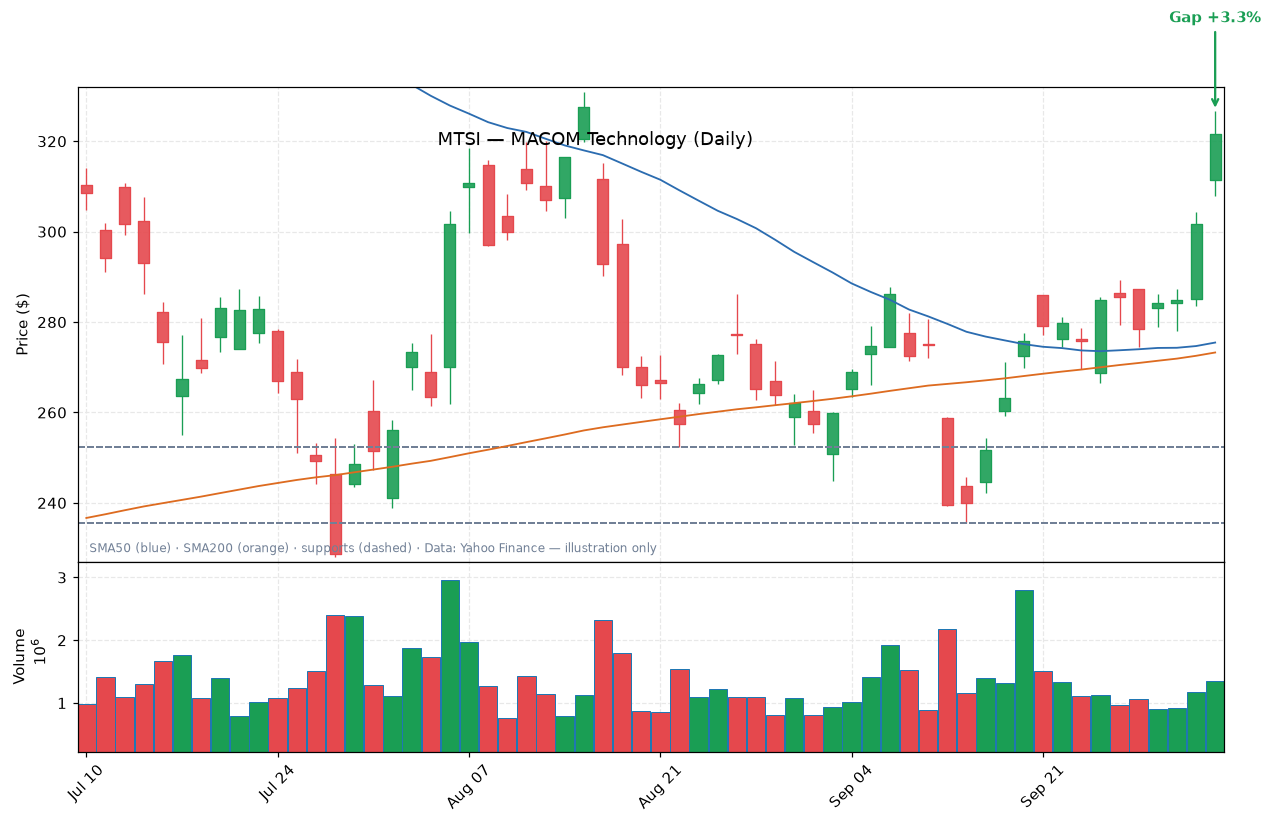
MACOM Technology Solutions — a smaller analog and RF semiconductor maker — gapped up 3.08% at Friday’s open, the weakest qualifying gap on the list, barely over the 3% bar. But unlike MRVL, the gap extended: MACOM closed Friday +6.62% at $321.60. The driver was the same Friday chip-sector rally on the weak jobs report that lifted TXN, TER, and MRVL — no company-specific news was identified Friday. Tier 2, news-driven.
The contrast with TXN is interesting: both were bare-minimum gaps on the same macro catalyst, but MACOM’s extended while TI’s merely held — suggesting real buying behind this one despite the thin open.
The numbers
- Opening gap: +3.08% (opened $310.90 vs Thursday’s $301.63 close) — the weakest qualifying gap, barely over the bar
- Friday close: $321.60 (+6.62% on the day) — gap held and extended
- Market cap: ~$24.56 billion · Friday volume: 1.35M vs 1.36M average (~1.0×, in line)
- 14-day RSI: 67.70 — above the ~63.0 large-cap semiconductor peer average
- Position vs trend: $321.60 vs 200-day moving average of $273.27 — comfortably above
- Tier: News-driven (sector momentum — the weak jobs report’s chip rally)
+6.62% — MACOM’s Friday close, doubling the +3.08% gap — the weakest gap on the list had one of the strongest intraday extensions.
Bull case vs bear case
The bull case: the gap extended intraday on average volume — real accumulation, not a passive sector ride — and the RSI and trend position are both clean. The bear case: a 3.08% gap is one bad tick from being noise, there was no company-specific catalyst, and at $24.6B MACOM is the smallest chip name here — sector rotation hits the small ones first on the way back down.
What to watch
Watch $310.90, the gap-open level. Holding above it keeps Friday’s story intact; a break below it would unwind the qualification’s weakest leg.
Open MTSI in TradingView
Disclosure: this is an affiliate link — if you sign up through it, The Gap Up may earn a commission at no extra cost to you.
Screen B: this week’s oversold bounces
Three beaten-down large caps snapped back hard this week — unlike last week, which produced zero Screen-B qualifiers.
CCL — Carnival
Carnival closed September 28 at $22.14, about 12.6% below its 50-day moving average — a genuinely beaten-down setup after falling 20% year-to-date into earnings. Tuesday, the cruise giant reported fiscal Q3 before the open: record revenue of $8.44 billion, all-time-high net income of $1.9 billion, adjusted EPS of $1.43 (beating ~$1.35–1.36 consensus), and raised full-year EPS guidance to $2.24, with record 2027 booked occupancy and pricing. The stock gapped open +10.16% at $24.39 and closed +13.41% at $25.11 on volume of 75.5 million shares — 2.88× the 20-day average. A textbook earnings-driven mean reversion: the catalyst was real, and the volume showed conviction. (stockanalysis.com; FXLeaders, Sep 30)
FICO — Fair Isaac
The wildest chart on this list. On September 29, the FHFA put rival VantageScore 4.0 on the same loan-pricing grid as FICO Classic and floated a two-bureau “bi-merge” credit system — FICO crashed −26.5% in a single day (its worst day in years), fell another −4.1% on September 30, and Bank of America downgraded it to Neutral while halving its price target to $700. At the September 29 low it closed at $617.87 with an RSI of just 16.4 — deeply oversold by any definition. Thursday brought relief: the FHFA approved FICO’s Direct License Program, and the stock gapped +7.18% at the open and closed +11.69% at $661.75 on 3.10× average volume — aided by BMO’s maintained Outperform ($1,150 target) and heavy retail dip-buying. A relief bounce with a real catalyst, though the fundamental FHFA overhang remains. (stockanalysis.com; abcmoney, Oct 2026; MarketBeat, Sep 30)
GEN — Gen Digital
Gen Digital (the consumer-cybersecurity house behind Norton, Avast, and LifeLock) closed September 29 at $20.85 with an RSI of 19.7 — deeply oversold after a September 24 selloff on a GoDaddy-bid story. Wednesday, it closed +5.61% at $22.02 on 1.66× average volume (19.49M vs 11.75M). No GEN-specific news or analyst action was identified for September 30 — this one is a technical bounce: an oversold stock catching a bid on a broad market-recovery day. The RSI stayed below 30 all week (28.73 at Friday’s close), so the oversold label still applies going into next week. (stockanalysis.com)
Scorecard: grading the September 25 picks
Grading the picks from last week’s scan. Every pick, no cherry-picking.
| Pick | Sep 25 close | Oct 2 close | Change | Held gap? | Verdict |
|---|---|---|---|---|---|
| AKAM | $113.92 | $108.92 | −4.39% | No | Wrong — the Anthropic-deal pop faded; broke below the $113.84 gap-day low |
| INTC | $123.00 | $119.33 | −2.98% | Yes | Mixed — drifted with the sector, but the $114.93 gap-day low held |
| ARM | $310.32 | $307.49 | −0.91% | Yes | Right-ish — essentially flat and held, though it faded from its +5% Friday gap open |
| MRNA | $198.89 | $190.01 | −4.46% | Yes | Mixed — pulled back 4.5% but never threatened the $159 gap-day low |
| AMD | $630.59 | $633.91 | +0.53% | Yes | Right — small gain, and the gap-day low of $582.27 was never in doubt |
| STX | $916.59 | $848.99 | −7.38% | No | Wrong — reports of Toshiba’s major HDD production expansion crushed storage Friday; broke the $861.27 gap-day low |
| LITE | $941.65 | $1,085.42 | +15.27% | Yes | Right — the star performer; extended the gap and never looked back |
Season record: 13 of 15 held their gaps. (8 of 8 held in the September 18 cohort, 5 of 7 in the September 25 cohort.)
The honest takeaway: last week’s picks were a wash at the index level — five of seven finished red on the week, but holding is the test that matters here, and five of seven did. The two failures were both story-driven unwinding: Akamai’s Anthropic pop had no follow-through, and Seagate’s +13.4%-then-faded Friday gap was already flagged as a head-fake in last week’s near-misses post — the Toshiba news just finished the job. LITE’s +15.27% extension was the call that paid for the misses.
The week in markets
- Fri 10/2 — Weak September jobs report crushes October hike odds: payrolls rose just +29K vs ~84–90K expected; unemployment ticked up to 4.2% (vs 4.1% expected); August was revised down to 133K from 162K. October Fed-hike odds collapsed to ~23–28% from 64% a week earlier (CME FedWatch). The Nasdaq rose +1.2% to 27,190.86 (its second-highest close, third straight weekly win, +0.5% on the week); the S&P 500 added +0.7% to 7,722.72 (−0.3% on the week); the Dow rose +0.5% to 51,176.96 (−1.3% on the week). Rate-sensitive chips led: the SOX index hit a 3-month high intraday (+2.3–3.4%), Nvidia made an all-time high, and lower yields powered Friday’s six gap-up semiconductors. (Investor’s Business Daily, Oct 2; Morningstar/Dow Jones, Oct 2)
- Week — Yields retreat from a 24-year high: the 10-year Treasury hit ~5.35% midweek — its highest since 2002 — before the weak jobs print pulled it back to ~5.27% on Friday; the 30-year ended around ~5.63%. The week’s rate whiplash was the macro backdrop behind both Friday’s chip rally and the earlier week’s risk-off mood. (Investopedia, Wall Street Journal, Oct 2)
- Fri 10/2 — Storage crash: Seagate −12% and Western Digital −10% on reports that Toshiba plans a major HDD production expansion — a supply shock for the memory-storage duopoly. (Investor’s Business Daily, Oct 2)
- Fri 10/2 — onsemi buys Synaptics for cash: ON Semiconductor and Synaptics announced a revised all-cash merger agreement at $123 per share (~$5.7 billion), replacing the June all-stock deal (~$7 billion), after an unsolicited competing proposal for Synaptics. ON closed +6%, Synaptics +14%. (Wall Street Journal, Barron’s, Investopedia, Oct 2)
- Fri 10/2 — Nike’s turnaround flounders: Nike reported fiscal Q1 2027 after Thursday’s close — EPS of $0.48 beat $0.43, but revenue of $11.21 billion missed $11.32 billion (−4.3% year over year), and FY2027 guidance was cut to a high-single-digit revenue decline with adjusted EPS of $1.15–$1.35 vs $1.67 consensus; China fell 26%. Shares fell ~9–10% in premarket Friday and closed −3.7% at $33.87. (Barron’s, Oct 2)
- Sep 29–Oct 2 — FHFA detonates FICO’s mortgage moat: the Federal Housing Finance Agency put rival VantageScore 4.0 on the same mortgage-pricing framework as FICO Classic and floated a two-bureau “bi-merge” credit system. FICO crashed −26.5% on September 29 (its worst day in years), fell another −4.1% on September 30, and BofA downgraded it to Neutral while halving its target to $700. Relief came Thursday when the FHFA approved FICO’s Direct License Program — the stock bounced +11.7%, then fell again Friday as the FHFA moved to require two bureau pulls instead of three. (abcmoney, Oct 2026; MarketBeat, Sep 30)
This post is for informational and educational purposes only — not financial advice. Read our full Disclaimer. See you next Friday after the close.


Leave a comment