
Earnings season produces the largest, most violent gaps in the market. A company reports after the close, the numbers surprise Wall Street, and the stock opens 10–20% away from where it closed. These moves are the reason gap trading exists — and the reason most beginners get hurt trying it.
This guide gives you a framework for thinking about earnings gaps clearly, whether you ever trade one or just want to understand the scans we publish every Friday.
Why Earnings Cause the Biggest Gaps
Most news is opinion — an analyst upgrade, a rumor, a sector rotation. Earnings are facts: revenue, profit margins, and forward guidance, released all at once while the market is closed. Every fund manager on earth reads the same numbers overnight and reprices the stock simultaneously. That’s why earnings gaps are bigger and more decisive than news-driven gaps.
Two things actually move the stock:
- The surprise vs. expectations — not whether results were “good,” but whether they beat what was already priced in. A company can grow 30% and still gap down if Wall Street expected 40%.
- Forward guidance — what management says about next quarter often matters more than the quarter just reported. A guidance raise on a modest beat gaps harder than a big beat with cautious guidance.
Before the Report vs. After the Gap
There are two completely different games:
Betting before earnings is gambling with extra steps. Options premiums swell before reports (implied volatility crush), so even guessing the direction right can lose money. Most professional gap traders don’t hold through the announcement — they trade the reaction.
Trading after the gap is the actual strategy: the news is out, the gap exists, and now you’re judging whether the move is real or a head-fake. This is what our weekly scan tracks.
A Simple Framework: Gap-and-Go vs. Gap Fade
After an earnings gap, the stock usually does one of two things:
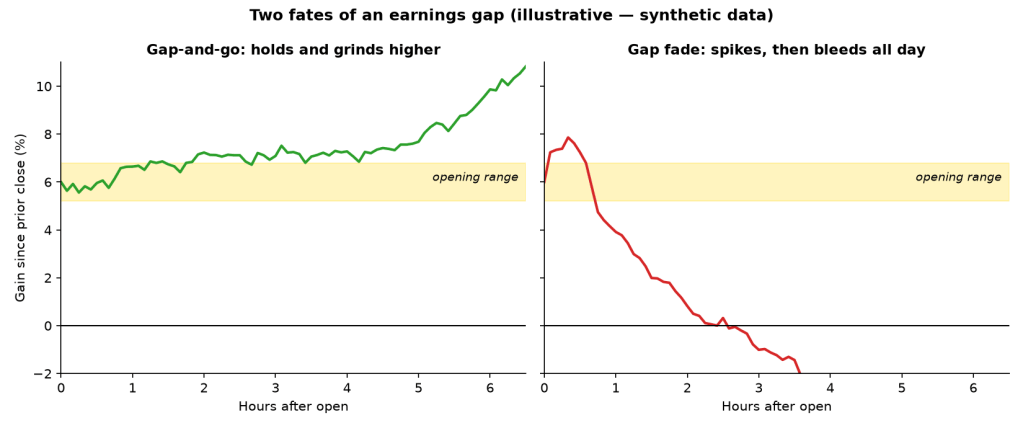
Gap-and-go (continuation): The stock holds above its opening price, volume stays heavy, and it grinds higher all day. Signs: the gap holds above the prior day’s high, pullbacks are shallow, and each intraday dip gets bought. This is institutional accumulation — funds building positions all session.
Gap fade (reversal): The stock spikes at the open, then bleeds all day, sometimes closing near where it started — or red. Signs: immediate selling into the open, heavy volume on down moves, loss of the gap-day low. This is distribution — early buyers selling to latecomers.
The practical rule: don’t decide in the first 15 minutes. Let the opening auction chaos settle. The direction of the first hour’s range break — above the opening range (strength) or below it (weakness) — tells you which scenario is playing out.
A Worked Example (Illustrative)
Walk through the framework with a hypothetical — XYZ Corp, a $40B software company:
- Wednesday 4:05 PM: XYZ reports revenue up 28% vs. 20% expected, and raises next-quarter guidance. Genuine double-beat.
- Thursday 9:30 AM: XYZ opens at $112, up +12% from Wednesday’s $100 close, on 3× average premarket volume.
- 9:30–10:30 AM: The stock chops between $110 and $114 — the opening range. You do nothing; this is the amateur hour.
- 10:45 AM: XYZ breaks above $114 on rising volume. That’s your signal: this is gap-and-go, not a fade. A disciplined entry goes above the opening-range high with a stop just under $110 (the bottom of the range, near the gap-day low).
- The alternative: if XYZ had instead broken below $110 by 10:30 AM on heavy selling, the trade is off — no entry, no hoping. The gap failed; the framework kept you out.
Notice what the framework never does: it never chases the 9:31 AM spike, never buys without a stop, and never confuses “great earnings” with “safe entry.” The numbers here are fictional, but the decision tree is exactly how professional gap traders operate.
Risk Management: The Rules That Keep You Alive
Earnings gaps are volatile enough to hurt. Non-negotiable rules:
- Position size small. A 15% gap can reverse 10% intraday. Size positions so a full stop-out costs no more than 1–2% of your account.
- Stop below the gap-day low. If the stock trades back below where the gap started, your thesis is broken. Exit — don’t hope.
- Never average down on a fading gap. Adding to a gap that’s filling is catching a falling knife with leverage.
- Take partial profits into strength. If you’re up 8% on a gap-and-go by midday, banking half locks in the win and lets the rest run risk-free.
- Avoid holding through the next catalyst. A gap-up into an upcoming Fed meeting or competitor’s earnings is borrowed time.
What History Says About Holding Gaps
The honest answer: it depends on the kind of gap. Breakaway gaps on genuine earnings surprises in market leaders have historically been the highest-probability continuation setups in swing trading — that’s the entire premise of momentum strategies. But most gaps are common gaps that fill within days, and chasing them at the open after a 15% pop is how beginners buy tops.
Our approach at The Gap Up: we don’t predict. We scan for gaps that meet strict quality filters (large-cap, 3%+ gap, heavy volume, above the 200-day average), then we grade whether they held through Friday — and publish the scorecard, wins and losses alike. The September 18 scan is a good example: seven gap-ups, all news-driven, each tracked through the week.
Common Mistakes
Chasing the open. The worst fills of the day go to market orders placed at 9:31 AM. Wait for the range to establish.
Confusing a good company with a good gap. Great businesses gap down on earnings too. Trade the price action, not your opinion of the company.
Ignoring the broader market. A stock gapping up into a market selloff faces a headwind all day. Check what the S&P 500 is doing before trusting any single-name signal.
No exit plan. Every gap trade needs three prices written down before entry: where you’re wrong (stop), where you take profit, and where you reassess (usually the first hour’s range).
Not financial advice. This is educational content about how markets work, not a recommendation to buy or sell any security.
Related: What Is a Gap-Up? · RSI Explained · This week’s scan


Leave a comment