
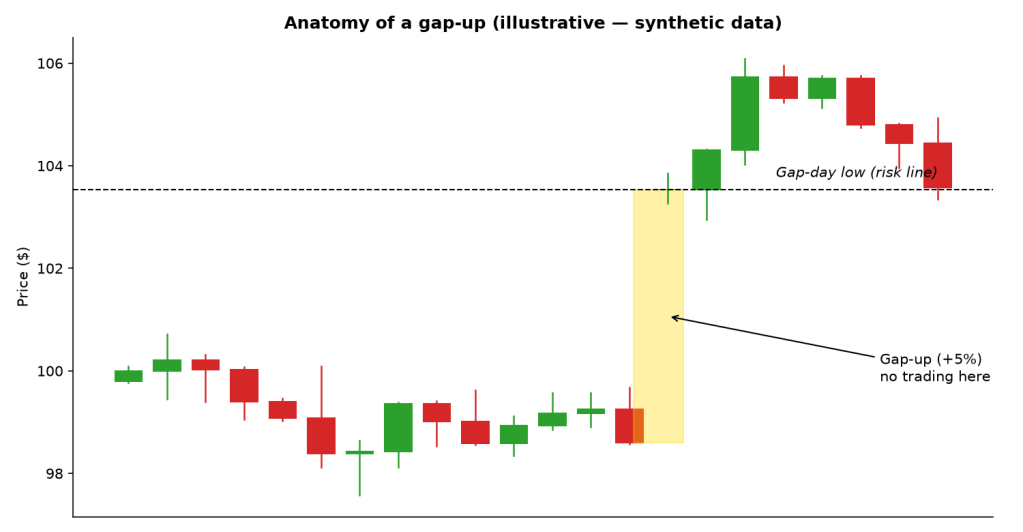
A gap-up is when a stock opens the trading day meaningfully higher than where it closed the day before — leaving a visible “gap” on the price chart where no trading happened. If a stock closes at $100 and opens the next morning at $105, that’s a 5% gap-up.
Gaps matter because they reveal urgency. Someone — usually a lot of someones — got news overnight and decided they couldn’t wait for the opening bell to buy.
Why Do Stocks Gap Up?
Most trading happens between 9:30 AM and 4:00 PM Eastern. But news doesn’t keep market hours. When material news breaks overnight or before the open, buy and sell orders pile up, and the opening price jumps to wherever supply meets demand. Common triggers include:
- Earnings reports — released after the close or before the open, the single most common cause of large gaps
- Guidance raises — a company telling Wall Street the future looks better than expected
- Analyst upgrades — a major bank raising its rating or price target
- M&A news — buyout offers and mergers
- Sector rotation — money flowing into an entire industry at once (like cybersecurity on September 14, 2026, when CrowdStrike, Zscaler, and Fortinet all gapped up the same morning)
- Macro news — Fed decisions, jobs data, or geopolitical developments
The 4 Types of Gaps
Not all gaps are created equal. Technical analysts traditionally classify them four ways:
1. Common gaps — Small, low-volume gaps in choppy or sideways markets. They usually fill within days and carry little information. This is noise.
2. Breakaway gaps — A stock breaks out of a trading range or consolidation pattern on heavy volume. These are the gaps that start real moves, because they mark a genuine shift in supply and demand.
3. Runaway (continuation) gaps — Gaps that appear in the middle of an already-strong trend, signaling the trend has further to go. Often driven by renewed conviction after new information.
4. Exhaustion gaps — A sharp gap near the end of a long advance, often on extreme volume and euphoric news. These can mark the top — everyone who wanted to buy just did.
Telling them apart in real time is the hard part, which is why confirmation matters more than classification.
What Makes a Gap-Up Worth Watching?
At The Gap Up, we don’t chase every gap. Our weekly scan only flags gaps that clear strict quality filters:
- Size: at least 3%. Smaller opening moves are noise — they fill too easily to mean anything.
- Large-cap only (over $10B market cap). Small caps gap on thin volume and reverse violently. Large caps need real money to move.
- Heavy volume. A gap on 2x average volume means institutions participated. A gap on thin volume is just a quote with no conviction behind it.
- Above the 200-day moving average. We want stocks already in long-term uptrends — gaps that continue strength, not dead-cat bounces.
- It has to hold. The real test isn’t the open — it’s Friday. A gap that stays above its gap-day low all week is strength. One that fades by lunchtime was a trap.
Real Example: ARM’s September 17 Gap
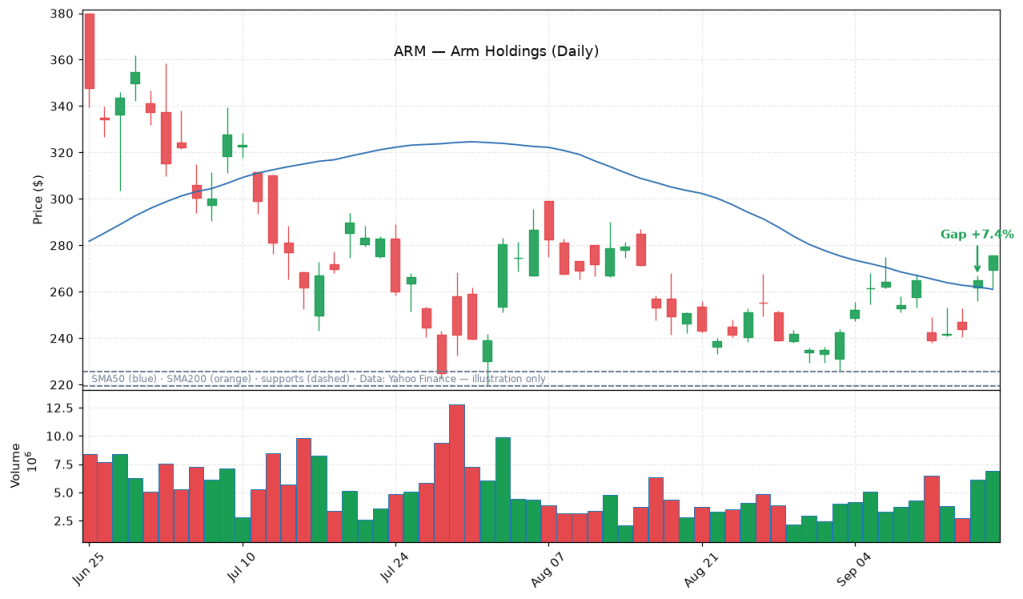
On September 17, 2026, Arm Holdings (ARM) opened +7.4% above its prior close — a textbook gap-up on 1.6× average volume. Here’s how it scored against the checklist:
- Size: +7.4% — well above the 3% noise threshold ✓
- Volume: 1.6× average — real institutional participation ✓
- Held: it stayed above its gap-day low all week and closed Friday at $275.61, up +4.1% for the week ✓
- Momentum: 14-day RSI of 57.7 — strong, but not stretched into overbought territory ✓
This is what a healthy gap looks like: real news, real volume, and buyers defending the gap all week instead of selling into it. (From our September 18 weekly scan.)
Gaps That Fail: The Bull Trap
Here’s what beginners miss: most gaps partially or fully “fill” — meaning the price drifts back down to where the gap started. A stock that gaps up 5% at the open and closes up 1% showed you everything: early urgency, then selling into strength.
The classic bull trap pattern:
- Big gap-up on exciting news
- Retail buyers chase the open
- Early buyers (who bought the news before you saw it) sell into the rally
- Price fades all day, sometimes closing red
This is why chasing a gap at the open is one of the most reliable ways beginners lose money. The professionals who bought overnight are often selling to the crowd arriving at 9:35 AM.
How We Track Gap-Ups at The Gap Up
Every Friday after the close, we run a systematic scan of the week’s gap-ups through the filters above and publish the qualifiers — with annotated charts, the catalyst behind each move, and an honest accounting of whether prior weeks’ picks held up. Stocks that almost made it get their own near-misses post, with the exact filter each one failed.
Frequently Asked Questions
Do gaps always get filled?
No — that’s a myth. Common gaps usually fill quickly, but breakaway gaps in strong trends can go months without filling. The “gaps always fill” rule causes traders to short strong breakouts and get run over.
Can you trade a gap-up before the market opens?
Premarket trading exists, but spreads are wide, volume is thin, and prices are volatile. Most beginners should wait for the regular session.
What’s the difference between a gap-up and just a big green day?
A big green day rallies during market hours. A gap-up opens higher — the move happened while the market was closed, which signals overnight urgency rather than intraday momentum.
Is a gap-up always bullish?
Short-term, yes — it shows buying pressure. But exhaustion gaps near the top of a long rally can mark the end of a move, not the beginning.
Not financial advice. This is educational content about how markets work, not a recommendation to buy or sell any security.
Related: How to Trade Earnings Gaps · RSI Explained · This week’s scan

